by Lisa Emanuelson | Jan 22, 2024 | News
GO-BGC’s Dr. Lynne Talley presented at COP 28. The ocean takes up more than 90% of the extra heat and 30% of the excess carbon dioxide produced by human activity that is exacerbating climate change. As a consequence, marine oxygen levels are dropping and marine...
by Lisa Emanuelson | Jan 22, 2024 | News
GO-BGC’s Dr. Lynne Talley presents at COP28. Marine heatwaves are a significant ecological and socioeconomic threat, worldwide, and have been increasing in both duration and frequency, a trend that is likely to continue. Though heatwaves at the sea surface can...
by Lisa Emanuelson | Aug 1, 2023 | News
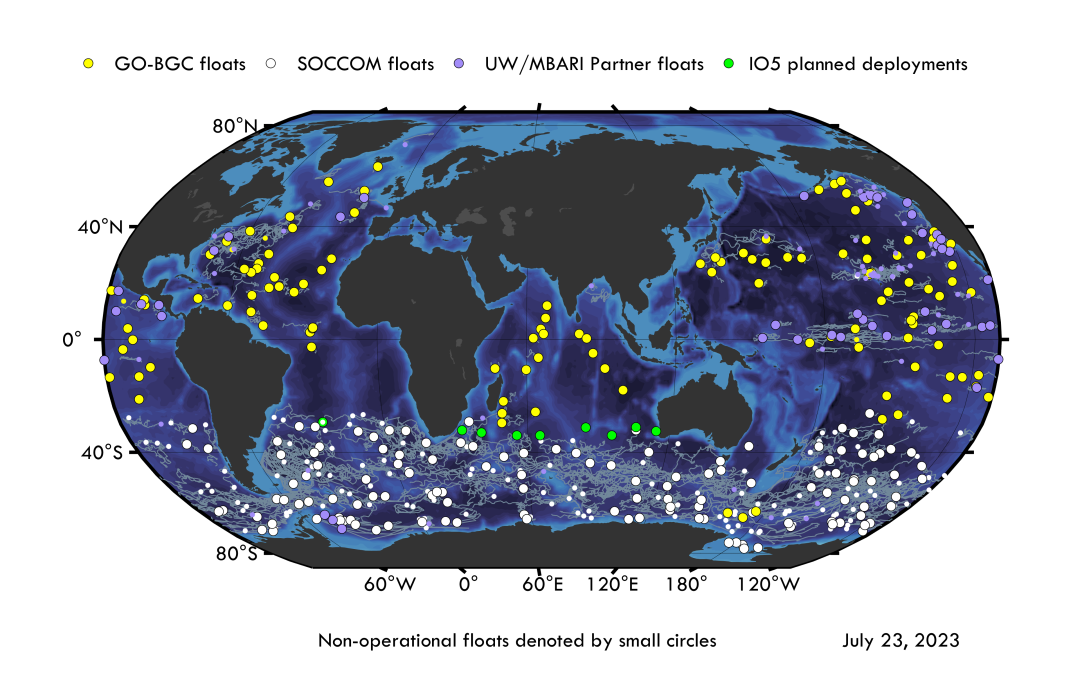
GO-BGC featured in the 2nd International Indian Ocean Expedition (IIOE-2) Newsletter The Indian Ocean has been one of the least sampled ocean basins in the BGC-Argo Array. Over the past year 25 biogeochemical (BGC) profiling floats have been deployed in the Indian...
by Lisa Emanuelson | Apr 25, 2023 | News
Accelerate your data analysis skills and launch new collaborations through this hands-on multi-day workshop focused on data from the Biogeochemical Argo global float array. Attendees will generate research ideas utilizing GO-BGC/BGC Argo float data and start working...
by Lisa Emanuelson | Sep 20, 2022 | News
Dr. Paul Chamberlain recently defended his PhD thesis “Semi-Lagrangian Float Motion and Observing System Design” at the Scripps Institution of Oceanography (SIO). Paul has studied and predicted where floats will go when they are underwater and the best...
by Lisa Emanuelson | Aug 27, 2022 | News
Dr. Susan Wijffels from Woods Hole Oceanographic Institution was awarded the Henry Stommel Research Medal by the American Meteorological Society for her exceptional contributions to understanding oceanic and freshwater storage and transport of heat, and monitoring...
