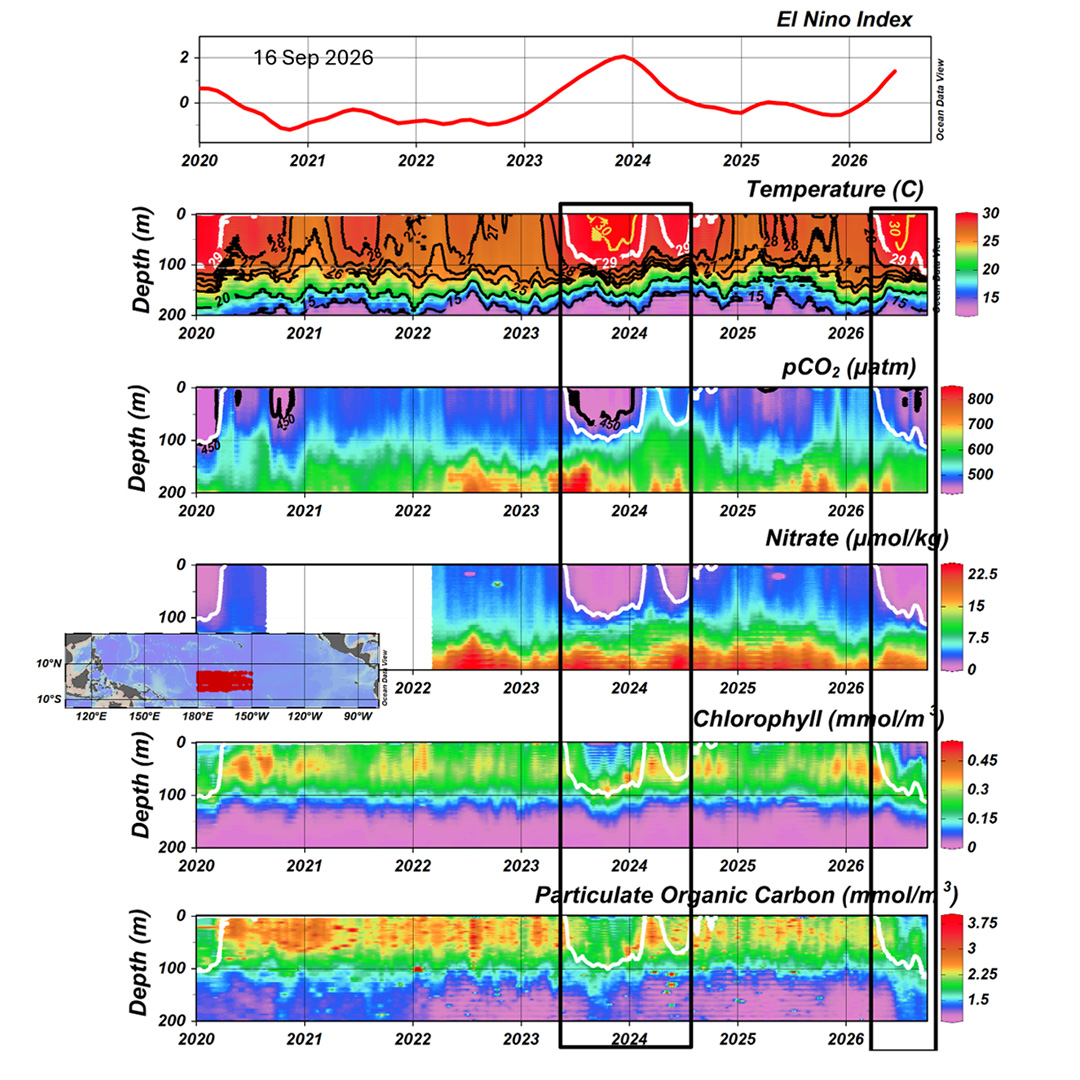
The BGC-Argo floats deployed by the GO-BGC project show the ecosystem impacts of El Niño in the equatorial Pacific. The following graphic shows the time evolution of ocean properties measured by sensors on floats in the upper 200 m of the water column since 2020 in the central equatorial Pacific. This area (3°N to 3°S, 180°W to 150°W) is a subset of the Nino3.4 region used to diagnose El Niño conditions.
The top graphic shows the El Niño index with positive values indicating El Niño conditions. Weak El Niños were see in early 2020 and mid-2023 to early 2024. The emerging signal of the current El Niño begins in early 2026. In this region, ocean temperatures rise above 29°C during the El Niños. Black rectangles enclose the El Niño times. A white contour line superimposed on each following plot shows the 29°C contour line.
During negative phases of the index (non-El Niño conditions), westerly winds along the equator drive upwelling that brings deeper waters to the surface. The upwelled water is cooler and never exceeds 29°C. These deeper waters bring high concentrations of carbon dioxide (shown as the partial pressure of carbon dioxide gas in the ocean, pCO2) and the plankton nutrient chemical nitrate to the surface. The high carbon dioxide and nitrate concentrations make the equatorial Pacific the strongest CO2 source from the ocean to the atmosphere and a region of high plankton productivity.
As the westerlies weaken, and even reverse n El Niño, upwelling weakens and the pCO2 and nitrate concentrations drop. Water temperatures rise. This is seen on the graphics of pCO2 and nitrate within the regions bounded by the white, 29°C contours. Nitrate concentrations decrease to values near zero and limit phytoplankton growth. Chlorophyll concentrations, indicators of phytoplankton biomass, drop to near zero close to the surface. The plankton must migrate into deeper waters to find the essential nutrients they require for growth. The amount of particulate organic carbon, deduced from optical backscatter sensors on the floats, also decreases. These ecosystem effects must ripple up the food web as less biomass is present to support higher trophic levels.
The decrease in partial pressure of carbon dioxide gas (pCO2) weakens the outflow of carbon dioxide to the atmosphere. This is a sort of ecosystem service that reduces the rate of atmospheric CO2 growth that occurs during El Niños due to effects of the climate shift on terrestrial plants.