
What’s a CTD rosette and why does it matter?
The one-ton instrument at the center of repeat hydrography — and what it reveals about a changing ocean.
6/5/2026
I’m on board the R/V Marcus G. Langseth in the tropical North Pacific, conducting repeat hydrography along GO‑SHIP section P04E, from the Marshall Islands to Panama. “Repeat hydrography” means we’re taking measurements of ocean physics, chemistry, and biology that can be compared with previous cruises along the same line. By repeating these observations, we can better understand how different parts of the ocean-atmosphere-climate system function, and how they are changing over time due to natural cycles and human influence.
On board, much of our work revolves around a yellow, one‑ton, cylindrical hunk of metal called the CTD rosette. CTD stands for the primary instrument it carries—conductivity, temperature, and depth—and rosette refers to its circular shape. Many additional instruments are strapped to the frame to measure things beyond temperature and salinity, including: oxygen, chlorophyll, current speed, and even a camera that photographs microorganisms living throughout the water column. Attached to the rosette are 36 bottles, each about 10 liters in volume, that can be closed at specific depths. Those bottles bring water samples to the surface for processing in labs on the ship. From those samples we can measure pH, trace gases, dissolved carbon, nutrients, and isotopes of water, oxygen, and carbon. Some samples are even sealed and shipped to labs on shore for DNA analysis to learn more about biological activity!
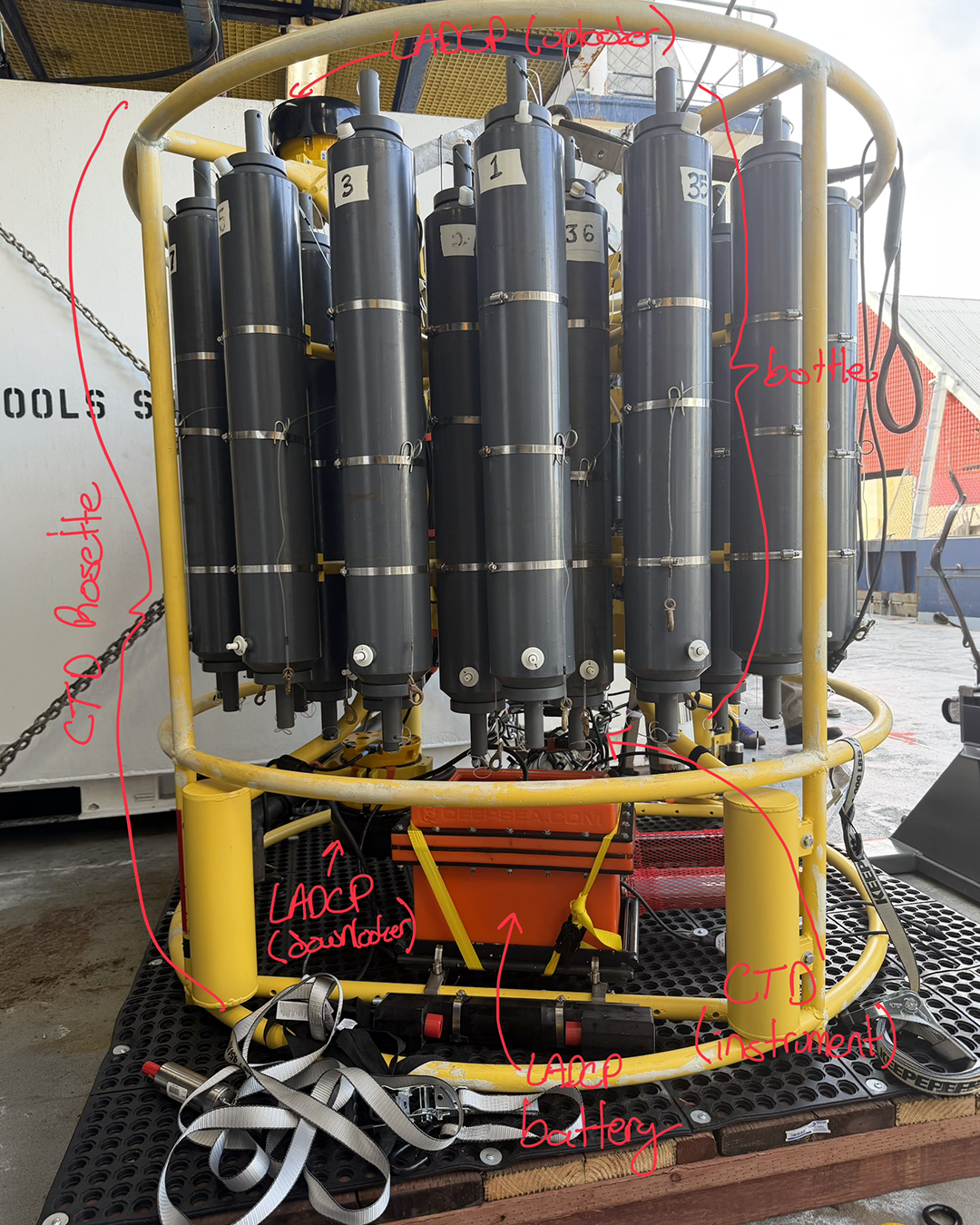
Annotated CTD rosette. Photo by Andrew Marshall Fagerheim
A typical cast—lowering the rosette from the surface to the seafloor and back while the ship holds its position steady—takes about 4-5 hours. When the rosette returns to deck, a flock of scientists meet it to download data from instruments, collect bottle samples, and perform maintenance. After that flurry of activity, everyone disperses to their labs to analyze samples and prepare for the next cast. We repeat this cycle continuously; on this cruise we’re scheduled to do a little over 100 casts!
In addition, at some stations we deploy autonomous instruments—surface drifters and Argo floats—behind the ship. These robots drift along with the currents for years, collecting data and transmitting it by satellite back to scientists on shore. These records both fuel basic research and also feed into operational weather forecasts, climate models, and fisheries management.
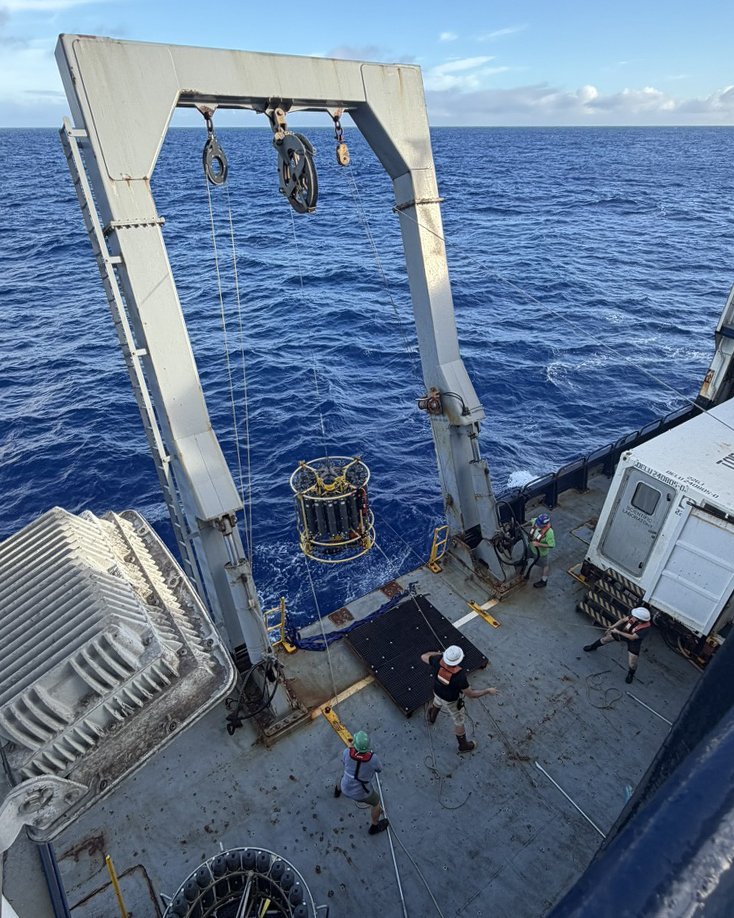
CTD recovery on deck. Photo by Andrew Marshall Fagerheim
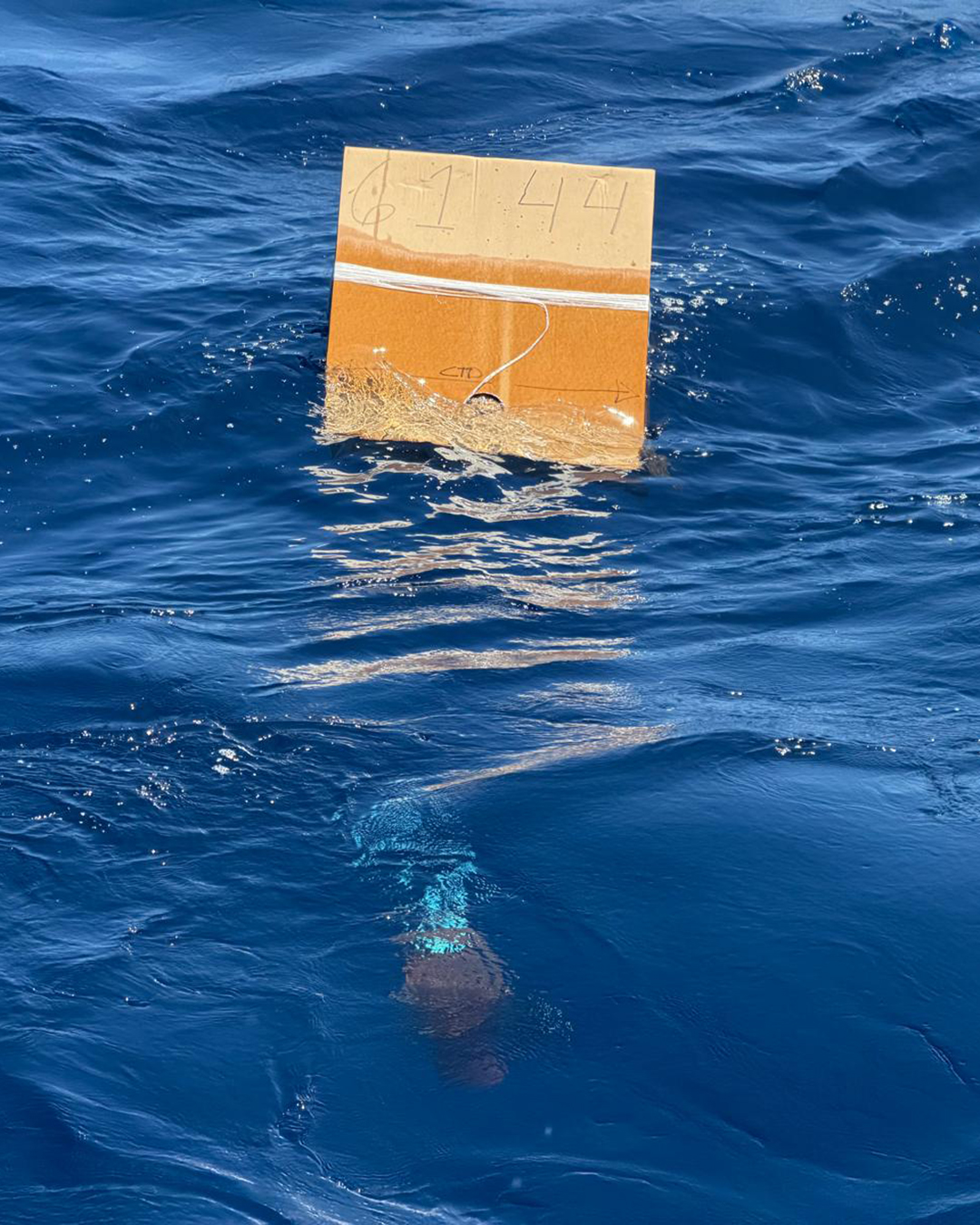
Deep Argo float deployment. Photo by Andrew Babbin
The datasets from this cruise will serve multiple purposes. Precise shipboard instruments can be used to calibrate sensors on the autonomous platforms deployed. Trace gas and oxygen profiles reveal how long water masses in the ocean interior have been out of contact with the atmosphere. Nutrient and chlorophyll data indicate how biologically productive a region is. Measurements of temperature, pH, and carbon help quantify how human activities are altering ocean physics and chemistry. Taken together, these observations form a baseline we can return to again and again, providing a way to understand fundamental ocean processes, detect change, and improve the tools we use to monitor and predict the ocean.
About the Author—Andrew Marshall Fagerheim is a second-year PhD student at Lamont-Doherty Earth Observatory and the LADCP operator on P04E. For work he studies ocean stirring and mixing using Argo float data, and for fun he enjoys crafting, playing board games, and seeing Broadway musicals.