
Life in the Water Column
From Southern Ocean icebergs to the oligotrophic gyre, the Bio-GO-SHIP team documented the full sweep of plankton biodiversity along A16S
04/29/2026
The Bio-GO-SHIP team, led on A16S by researcher Star Dressler and graduate student Amy Nuno (both of University of California, Irvine), has had the privilege of collecting a comprehensive suite of biological measurements on the full A16 North (2023) and South (2026) transects.
On A16N, traveling from south to north, the transect began in regions of elevated productivity associated with Sargassum blooms and concluded near Iceland during the North Atlantic spring phytoplankton bloom. On A16S, the cruise began in the Southern Atlantic bergy bits of the mega-iceberg A23a, and concluded in equatorial transition zones. On the morning of 28 April– the final day of A16S transit sampling– the team sampled in Sargassum patches, marking a full-circle moment.
The mosaic of biological sampling efforts on A16S captures phytoplankton dynamics in complementary ways, providing a multidimensional view of shifts in productivity and biodiversity along the transect. Gathering discrete DNA, RNA, HPLC pigments, flow cytometry, particulate organic matter, and microplastics, the bio team completed 165 underway sampling stations, including data validation stations during overpasses of the PACE satellite, and 26 CTD stations. This totals nearly 2,000 individual preserved samples as well as two continuous inline datasets (particulate backscatter and IFCB).
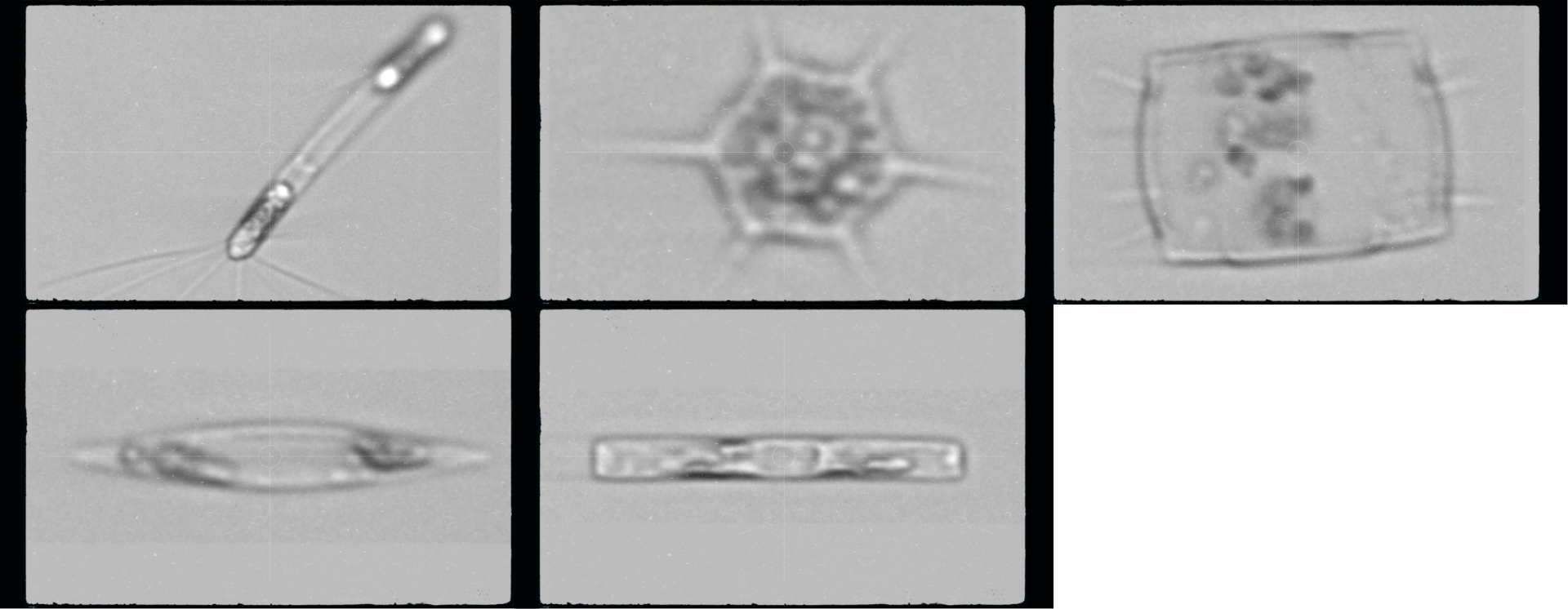
On A16S, the McLane imaging flow cytobot (IFCB) captured planktonic biodiversity spanning the highly productive and bergy waters of the Southern Atlantic to the oligotrophic desert of the South Atlantic Gyre, and many zones of transition in between. In southern high seas near icebergs, the plankton community was likely dominated by diatoms, illustrated in the IFCB images above. Clockwise from the top left, the diatoms are tentatively identified to genus as Corethron, Dictyocha, Odontella, Navicula, and Leptocylindrus.
About the Author—A16S Bio-GO-SHIP team