
The Magnificent Seven of Leg 1
Details on the deployment of the first seven Argo floats deployed on “leg 1” of A16S.
03/30/2026
Hello from the South Atlantic/Southern Ocean (depending on what definition of the boundaries of the Southern Ocean you use)! My name is Zack Nachod, and I am a PhD candidate at the University of Hawaiʻi at Mānoa. On A16S, I am serving as this cruise’s “float wrangler,” where I manage the preparation and deployment of Argo floats onboard the ship. Our cruise departed from Punta Arenas the night of March 9th, setting sail to our first station.
After a 3-day transit from Punta Arenas, the day finally came to deploy our first floats into the Southern Ocean! One core float (serial number: 7919, WMO: 3902745) and one BGC float (serial number: 4027, WMO: 7902382) were released on March 12th, 2026 at 4:44 and 11:48 (UTC) at the coordinates 55˚ 14.311′ S, 56˚ 03.532′ W and 55˚ 39.261′ S, 55˚ 39.956′ W, respectively.
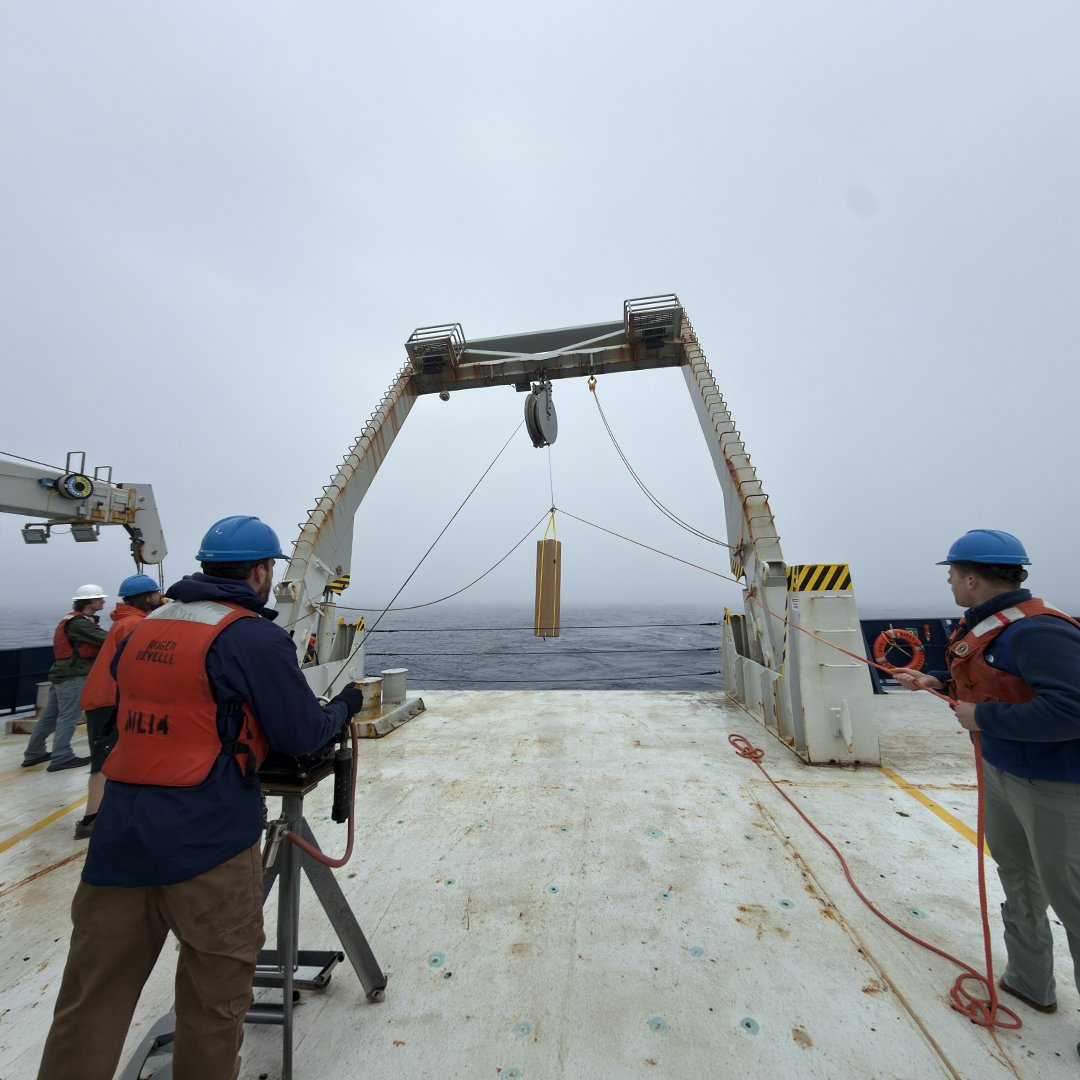
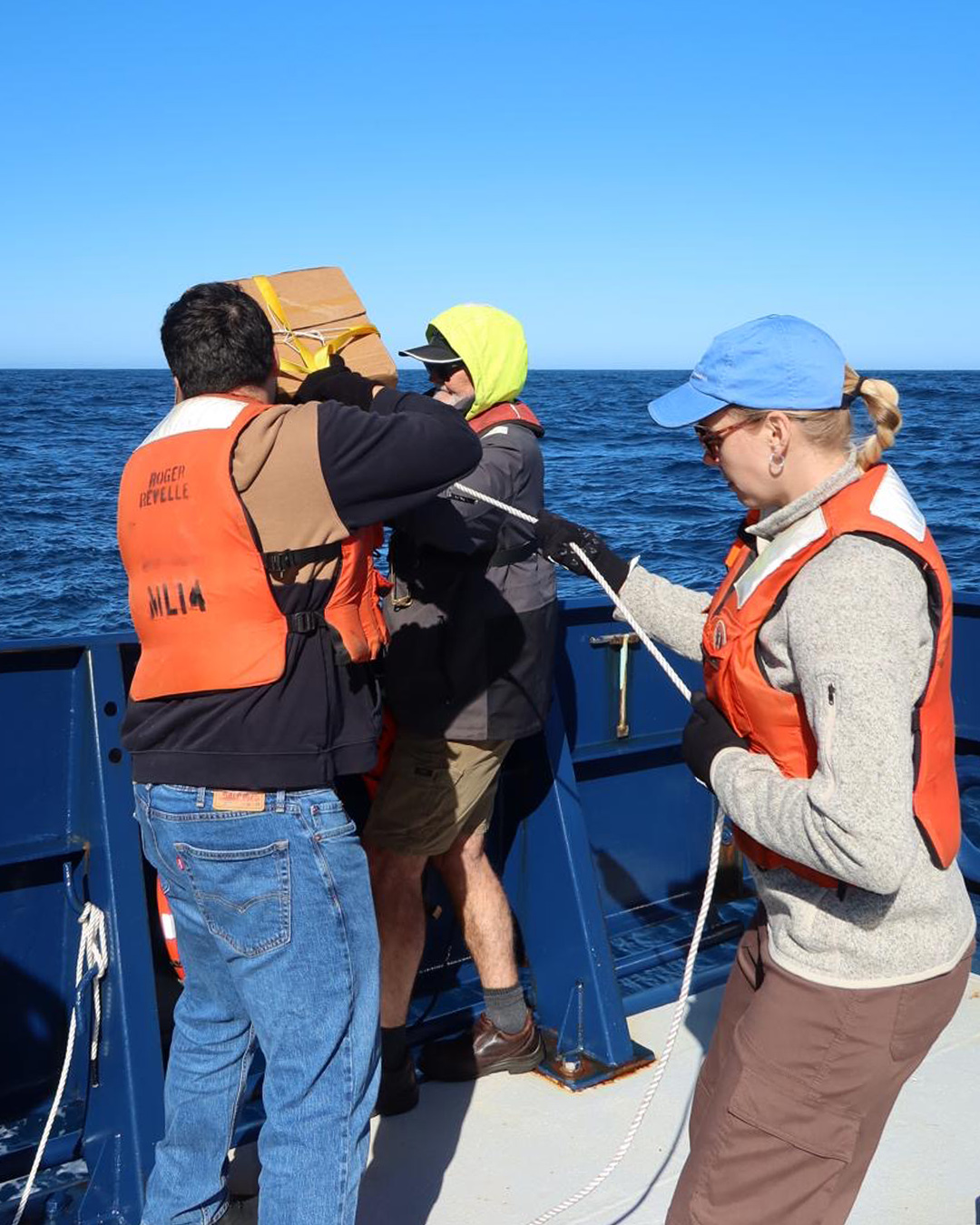
Daniel Sandborn (CFCs), Anson Antriasian (CFCs), Zach Kaufman (CTD watch), and Noah des Rosiers (Restech) deploy a boxed BGC float from the ship’s A-frame.; Photo credit: Zachary Nachod
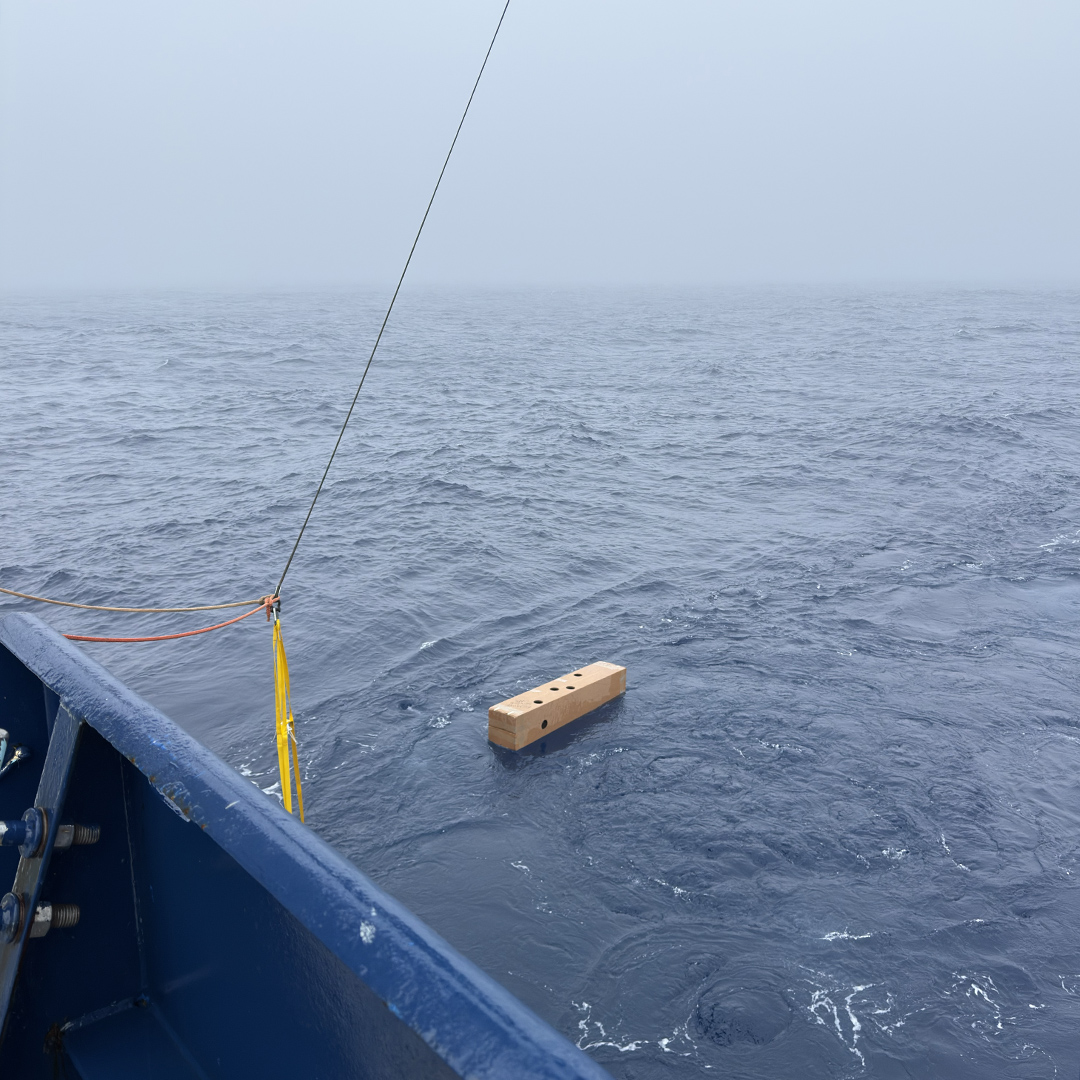
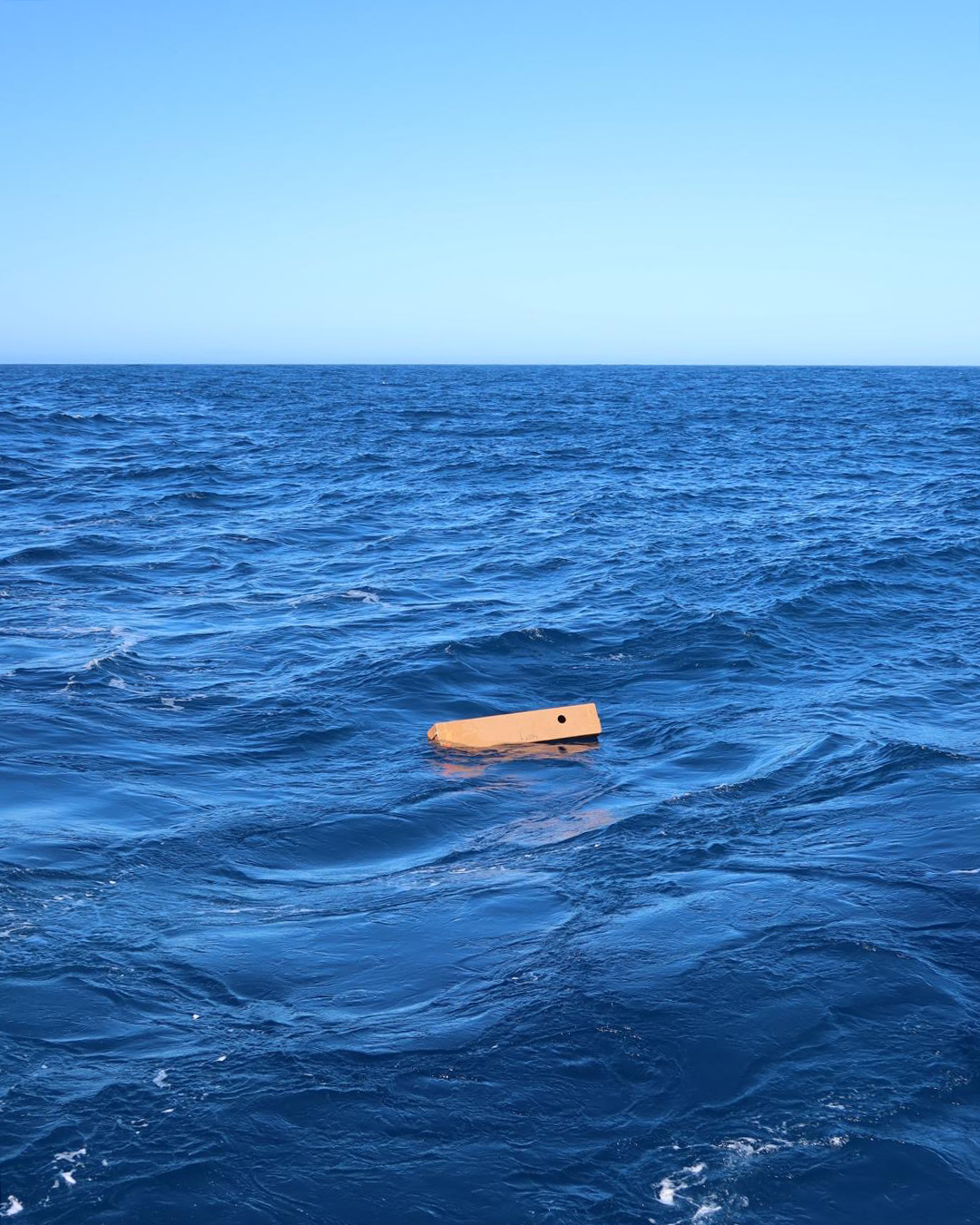
Boxed BGC float floating away just after deployment.; Photo credit: Zachary Nachod
Core floats are equipped with a CTD, which measures salinity, temperature, and pressure—standard physical oceanographic variables that can further be used to calculate the density of seawater. The observations of these variables are important for studying ocean heat content, ocean circulation, mixing, and more. BGC, or biogeochemical, floats are equipped with not only a CTD, but many more sensors compared to their core float counterparts. These additional sensors measure oxygen, nitrate, pH, chlorophyll-a, suspended particles, and downwelling irradiance (light).
There are a few methods by which floats are deployed, and we have used all of them on these first seven floats. Two of the methods involve floats that are in a dissolvable cardboard enclosure (“boxed”), with the last requiring no additional housing around the float. Boxed floats are most commonly deployed by carefully lowering them over the side of the research vessel and releasing them into the ocean upon contact with water. An alternative method, in case the water-release mechanism fails, is to set up two lines that wrap around the box, which are then slowly unraveled as the float is lowered down the side of the ship.
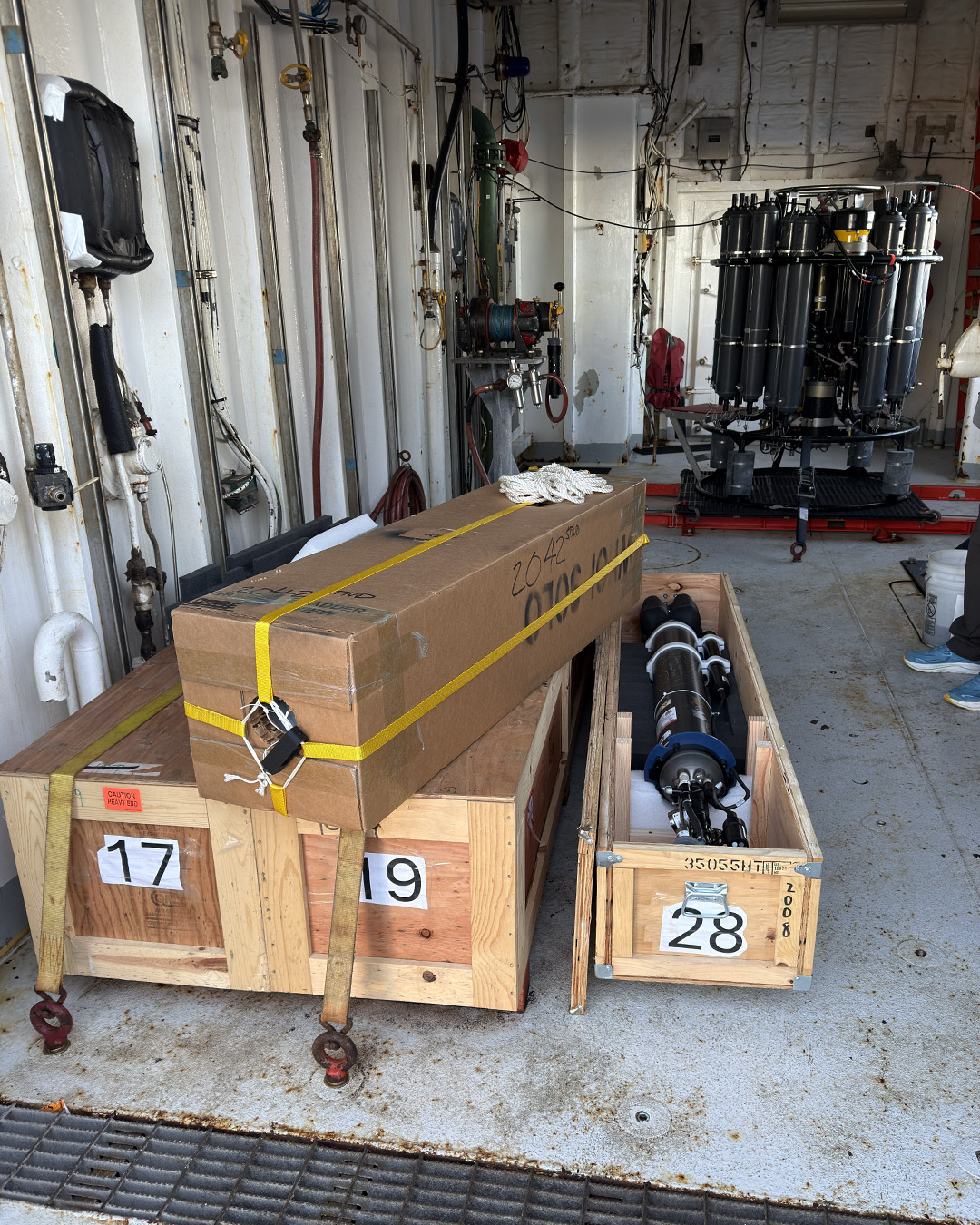
A boxed core float next to its unboxed NAVIS BGC float counterpart. The water release mechanism can be seen at the bottom of the cardboard box.; Photo credit: Zachary Nachod
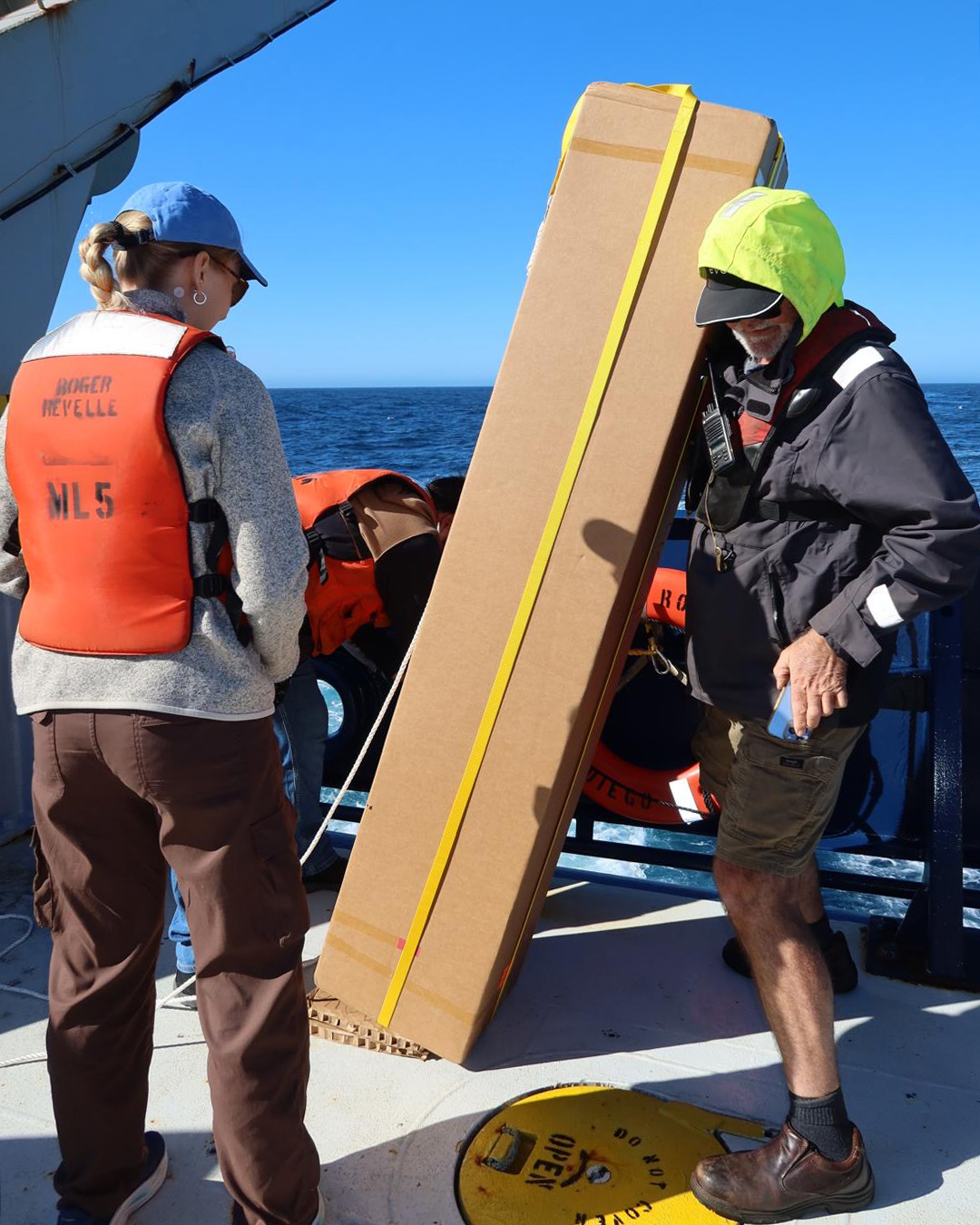
Zack Nachod, Reese Barrett (pH), and Doug Penny (Restech) prepare a boxed core float for deployment.; Photo credit: Reese Barrett
Zack Nachod, Reese Barrett, and Doug Penny lifting a boxed core float over the side of the ship; Photo credit: Reese Barrett
Boxed Core float drifting away after being deployed!; Photo credit: Reese Barrett
The next day, we ran into mechanical issues and had to turn back to Punta Arenas for repairs. On the unexpected return transit, we deployed an additional 5 floats (3 core and 2 BGC)! Thanks to the hard work of the crew, we are now back out at sea for “Leg 2” of A16S!
The last float we deployed is our first float to be “adopted” by students back on land the the Adopt-a-Float program. This NAVIS BGC float is named OceanStreak (serial number: 2008, WMO: 5907251) and was adopted by Hommocks Middle School (Mamaroneck Union Free School District) in Larchmont, NY. You can follow this float’s journey by entering its identifiers into Argo data access websites like the Argo Fleet Monitoring website or the GO-BGC data access page. You can also find real-time data from this and other BGC floats on the GO-BGC website. Use one of the interactive maps to look for OceanStreak—just search for the Float-ID 2008. You can also find information on key parameters measured by each adopted float on the AdoptAFloatViz page.
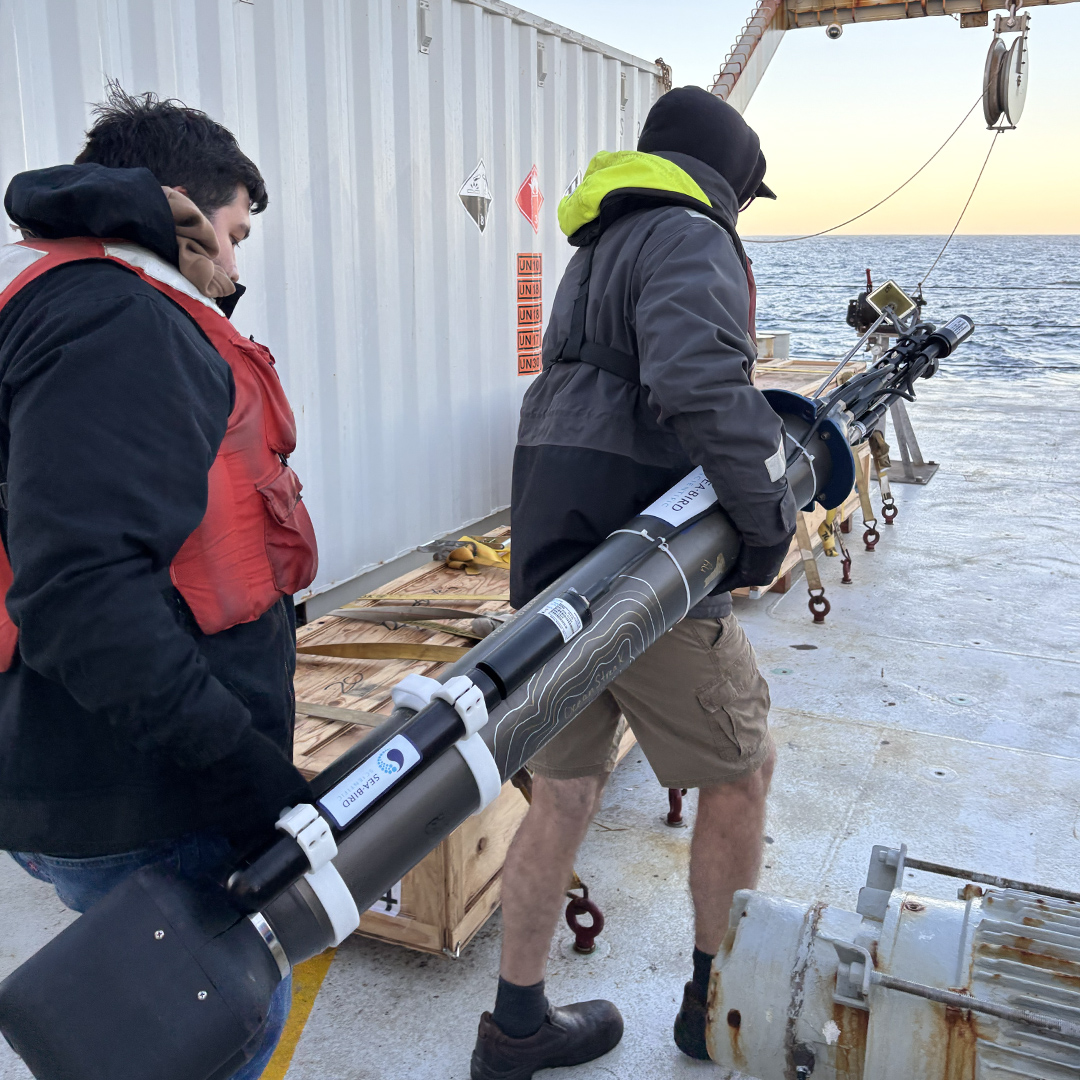
Zack Nachod and Doug Penny carrying OceanStreak on deck to be deployed.; Photo credit: Zachary Nachod
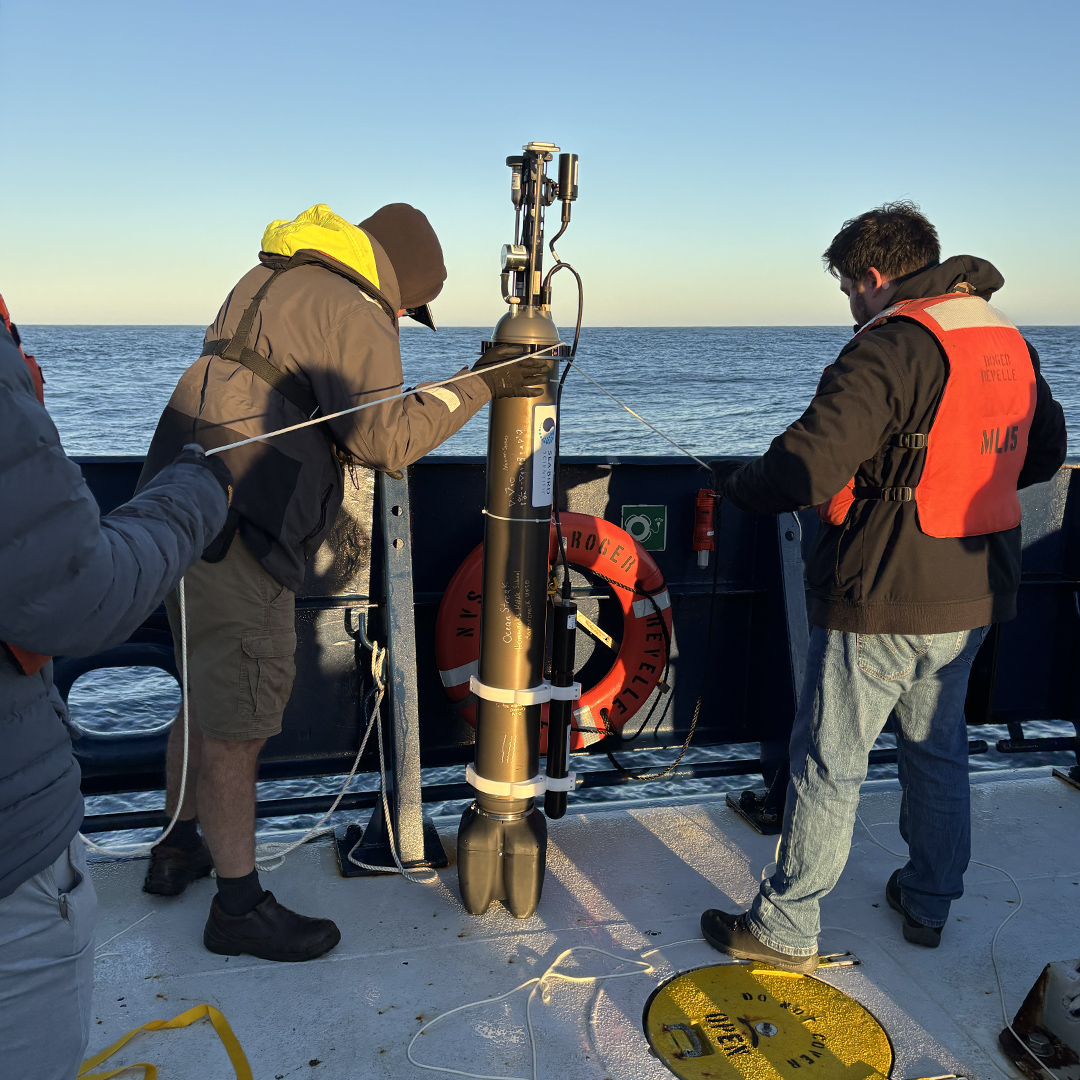
Zack Nachod, Doug Penny, and Jay Hooper (CTD) running a deployment line through OceanStreak’s deployment disk. This line is used to lower the float carefully into the water over the side of the ship.; Photo credit: Zachary Nachod
We plan to deploy 32 total floats during this cruise, which means we have 25 to go over the next month while we travel to Cabo Verde!
About the Author— Zachary Nachod is a PhD candidate at the University of Hawaiʻi at Mānoa in Honolulu, Hawaii. Onboard A16S, Zack is the float wrangler in charge of managing Argo float deployments and collecting HPLC and POC samples as validation data for the cruise’s BGC floats.