
The Data Ocean
Visualizing the rhythm, scale, and structure of a GO-SHIP cruise — one sample at a time
05/04/2026
What does an oceanographic cruise like GO-SHIP really look like, not as spreadsheets or station logs, but as a living flow of data? For this visualization, I stepped away from maps and tables and imagined the cruise as a fluid ocean itself: stations drifting like moments, each one carrying layers of information. CTDs, biocasts, underway sampling and floats deployments—each translated into color, shape, and motion. Total alkalinity becomes a blue asterisk, DIC a soft turquoise triangle, and each property pulses with its own color and form. Instead of decoding columns, you can feel the structure of the data, the rhythm of sampling, the way knowledge accumulates across space and time.
Because behind every clean dataset lies an overwhelming density of measurements. Nearly 100 stations, dozens of bottles per cast, multiple properties, duplicates, continuous underway sampling, on the order of ~25,000 individual samples collected throughout the cruise. That scale is hard to grasp in numbers alone. But when reimagined visually, it becomes something tangible: a layered, dynamic system that reflects both the ocean and the effort to understand it. Sometimes, making science visible means letting it be a little more human, a little more artistic, and a lot more intuitive.
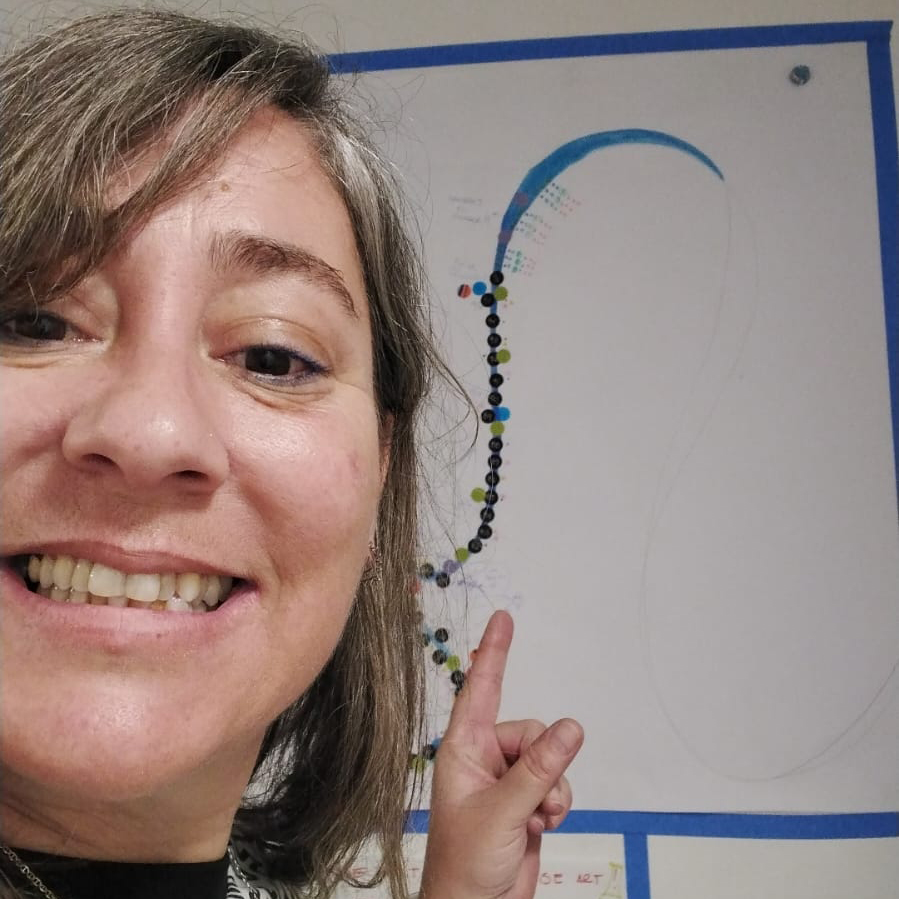
Data visualization artist Carla Berghoff points to her A16S map.
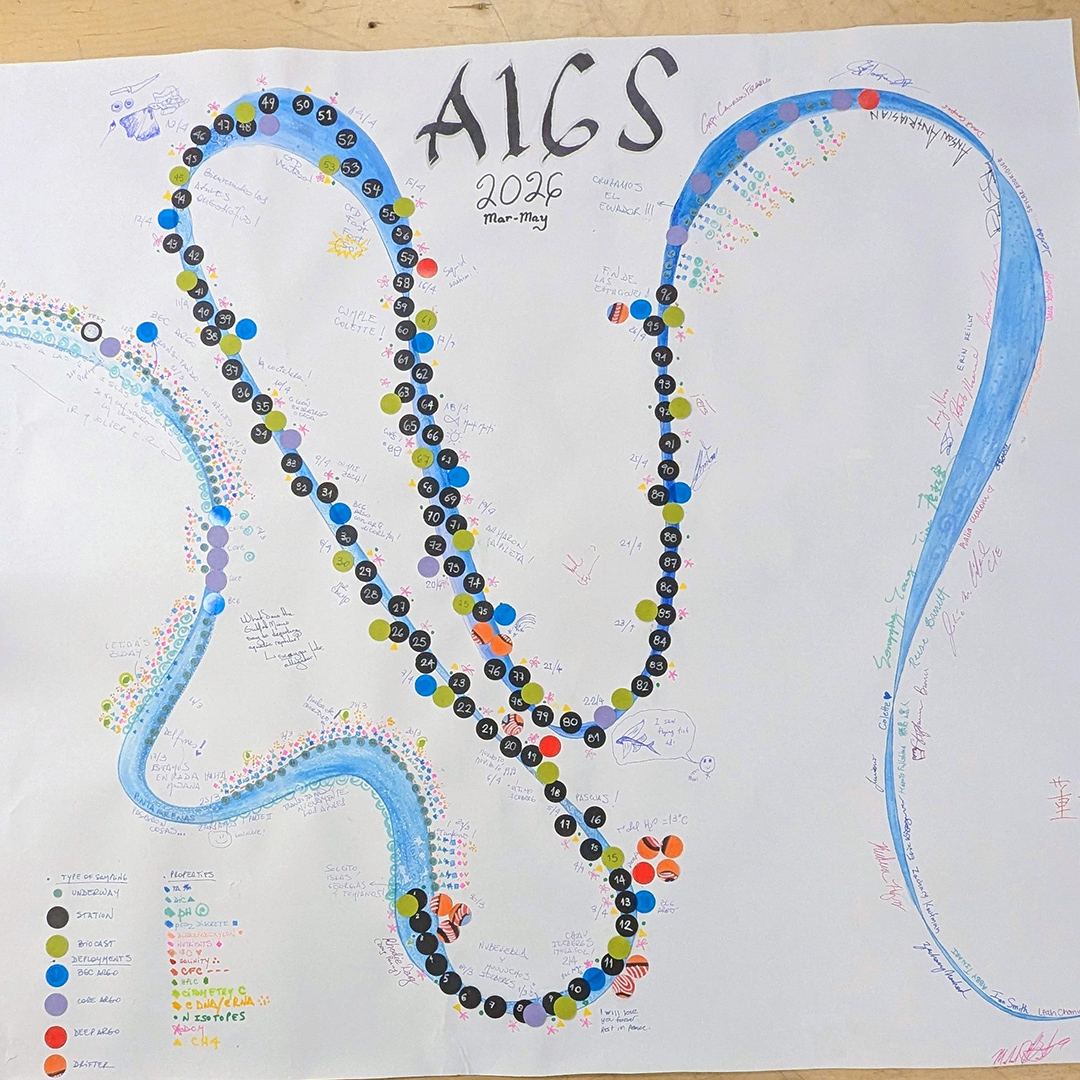
Visualization of the A16S sampling.
About the Author—Carla Berghoff is a researcher in the Dynamics of Marine Plankton and Climate Change program at the National Institute for Fisheries Research and Development (INIDEP) in Mar del Plata, Argentina. On A16S, Carla is serving as a scientist on the discrete pCO2 team on top of being one of our observers.